
Risk in slot machine play has both a mathematical side and a psychological side. Mathematically, risk relates to the probabilities and financial consequences of possible outcomes. Psychologically, it concerns how players interpret those possibilities and how much uncertainty they believe they face.
The two perspectives do not always match. A game may appear friendly because it offers frequent small payouts, while its overall financial return remains unfavourable. Understanding this difference helps explain why game presentation can shape perceptions of risk.
Mathematical Risk Versus Perceived Risk
Mathematical risk can be studied using probability distributions, expected value, and measures of variability. These calculations describe the possible outcomes under the game’s stated rules.
Perceived risk is the player’s subjective assessment of how uncertain or threatening those outcomes feel. It may be influenced by previous experiences, the size of the stake, visual design, and expectations about future rewards.
For example, a player might feel comfortable making many small wagers because each individual amount appears modest. However, repeated wagers can create significant cumulative exposure.
If someone places 40 wagers of ₹25, the total wagering is ₹1,000. The small size of each stake does not remove the financial risk of the full session.
The Effect of Frequent Small Payouts
Some games produce frequent small payouts alongside less frequent larger ones. This distribution can affect how the game feels.
A player may remember several payout events and interpret them as evidence that the game is generous. But a payout is not necessarily a net gain. If the amount returned is smaller than the total wager, the player has still lost money on that round.
For example, a ₹50 wager followed by a ₹20 payout produces a net loss of ₹30. A bright animation may emphasise the payout, but the arithmetic remains unchanged.
Looking at net results over time gives a more accurate view of financial performance than counting payout events.
Volatility and the Experience of Risk
Volatility describes how widely outcomes can vary. In slot games, it is often used to describe whether payouts tend to occur more frequently in smaller amounts or less frequently in larger amounts.
A lower-volatility game may provide smaller payouts more often, while a higher-volatility game may produce longer stretches without a substantial payout alongside the possibility of larger prizes. These descriptions depend on the specific game’s design and should not be treated as universal guarantees.
Volatility is different from expected return. Two games can have similar theoretical return-to-player percentages while distributing payouts very differently.
Players should therefore examine both the stated return information and the game’s payout structure where reliable details are available.
Near Misses and the Feeling of Being Close
A near miss is an outcome that resembles a winning combination but does not qualify for a payout. It can feel as if success was narrowly missed, even though the visual closeness may have no mathematical significance for the next spin.
Research has found that near misses can influence motivation and responses to slot outcomes, although the effects vary across studies. <Cite refs={[“turn803600search7″,”turn803600search4”]}/>
A near miss should not be interpreted as evidence that the player has a better chance of winning next time. Unless the game’s rules establish a dependency, each spin’s probability is determined by the underlying mechanism, not by how close the previous display looked.
The Illusion of Control
Players sometimes believe that their timing, personal rituals, or choice of button can influence a result that is actually determined by chance.
This is known as an illusion of control. It can make an uncertain activity feel more manageable than it really is.
Slot machine interfaces may provide interactive buttons or stop controls, but the presence of an interaction does not necessarily mean the player can influence the outcome. The effect depends on the specific game’s rules and mechanics.
Clear explanations of how outcomes are determined help reduce confusion between interface control and outcome control.
How Sound and Visuals Affect Risk Perception
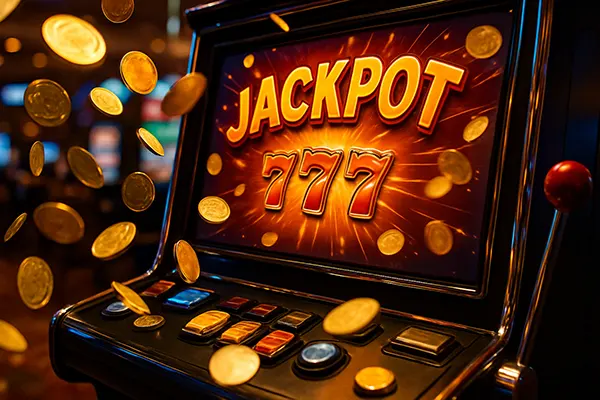
Bright symbols, celebratory sounds, animations, and dramatic reel stops can influence emotional reactions. These features can make outcomes feel more significant and keep attention focused on the game.
Research on slot machine sound has found that audio feedback can affect physiological responses, subjective experience, and preferences for playing with sound. <Cite refs={[“turn803600search8″,”turn803600search11”]}/>
However, sensory excitement is not a measure of financial value. A game that feels lively or rewarding may still have a negative expected return.
Players can make more informed decisions by separating the emotional response to an outcome from its actual monetary result.
Practical Ways to Assess Risk More Clearly
Players can improve their understanding of risk by checking the following:
- The stake per spin and the total amount wagered.
- The game’s payout rules and any available return information.
- Whether a displayed payout exceeds the total wager.
- The possible range of outcomes and the game’s volatility.
- The time spent playing and the change in the available balance.
Setting a fixed entertainment budget and time limit before playing can also help prevent repeated decisions from gradually increasing exposure.
Conclusion
Risk perception in slot machines is shaped by more than probabilities. Frequent small payouts, near misses, interactive features, and sensory feedback can influence how players interpret the experience.
The most reliable assessment combines mathematical information with awareness of psychological effects. A game that feels less risky is not necessarily safer financially, and neither a near miss nor a series of payouts guarantees a better result on the next spin.
FAQs
What is the difference between actual risk and perceived risk?
Actual risk relates to the probabilities and financial consequences of outcomes. Perceived risk is how a person subjectively interprets those possibilities.
Does frequent payout activity mean a slot game has better odds?
Not necessarily. Some payouts may be smaller than the amount wagered, and payout frequency alone does not establish the game’s overall return.
What does slot machine volatility mean?
Volatility describes how widely payouts and losses can vary. It does not, by itself, indicate whether a game has a favourable expected return.
Can sound effects change the odds of a slot machine?
Sound effects influence the experience, but they do not change the mathematical odds unless the game mechanics themselves are different.
5 thoughts on “How Players Perceive Risk When Playing Slot Machines”